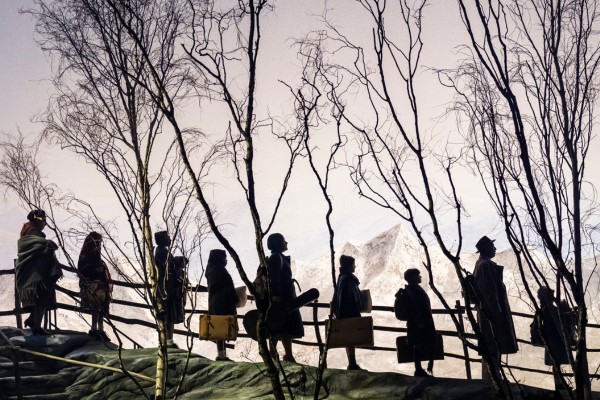
There’s a point at the very end of Rodgers and Hammerstein’s The Sound of Music where I wonder if, this time, the von Trapps might not make it. Rationally, we all know how it ends, with the family setting off across the hills. But what if…?
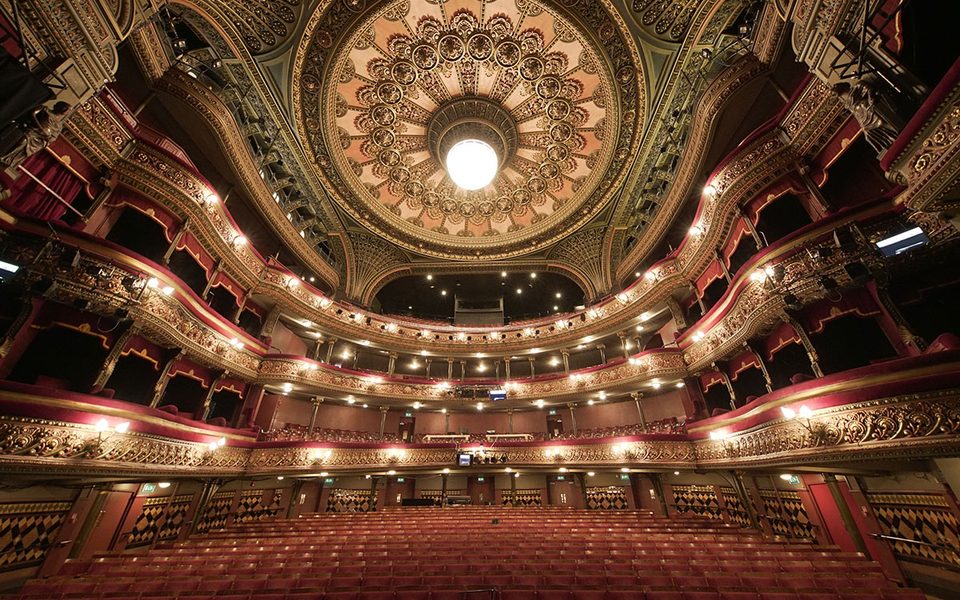
I couldn’t resist, as part of my Yorkshire tour of (mainly) the Ryedale Festival, making a slight detour to the opulent Grand Theatre in Leeds (and if you haven’t been to this fabulously restored example of late Victoriana, you’re missing a treat). Opera North’s performance certainly confirms the company’s excellence in staging musicals, following their critically acclaimed My Fair Lady (2024) and A Little Night Music (2021). The West End or Broadway might offer a Sound of Music as good as this, but certainly no better.
And of course, the von Trapps do make it. The continuing appeal of the Rodgers and Hammerstein masterpiece is that, on the one hand, it’s a sweet and simple story accompanied by great tunes. But on the other, there’s something far more complex: how bystanders can become collaborators; how society can be reduced to barbarism; how standing up for one’s principles can be mortally dangerous. I was curious, then, to explore how Opera North would balance all of these things.
The 1965 film actually shifts the ending. In the original 1959 stage version, Liesl’s beau, the Nazified Rolf Gruber, allows the von Trapps to escape. In the film, he dobbs them in. But as, in any case, both versions take dramatic liberties with the von Trapps’ actual story (in real life, they escaped using the less theatrical means of a train to Italy), both endings are fiction.
If, though, as the stage version suggests, Rolf has this spark of goodness all along, but in the film he turns out to be a total rotter, then surely that impacts on how he’s portrayed earlier on in the drama. Either way, when Rolf sings, in ‘Sixteen Going on Seventeen’, “Totally unprepared are you, to face a world of men; timid and shy and scared are you, of things beyond your ken”, it could be heard as a warning. In other words, he’s telling her that she hasn’t a clue of what’s about to happen, of how “the world of men”, of which he’s part, will cause worldwide destruction.
Interestingly, in Opera North’s staging, Kamil Bien’s excellent portrayal of Rolf came over as a little sinister from the start; there was something ‘off’ about his character. So when, at the end (and unlike in the film), he doesn’t grass on the von Trapps, because he still holds a light for Liesl, his moment of goodness is even more contrasted. In the film, Daniel Truhitte plays Rolf as the wholesome boy next door, only for us to discover that he’s a totally bad egg.
Opera North’s Finale Ultimo of ‘Climb Ev’ry Mountain’ shows Rolf removing his Nazi regalia. Across the stage appears a figure in the striped uniform of a concentration camp prisoner. Is this Rolf at a later date, interned alongside anti-Nazi Austrian political prisoners? Or might it represent the fate Captain von Trapp narrowly avoided? It’s a haunting visual that grounds the final moments of this production in stark historical reality.
There are any number of curious features about the songs. ‘Climb Ev’ry Mountain’ (powerfully sung by Katherine Broderick) is normally in the key of C, but in the film, the arranger and orchestrator, the wonderful Irwin Kostal, puts it in the key of B flat. For the central section, Kostal manipulates Rodger’s original and sends it off into the key of C flat, and he then ends the song in the key of C.
C flat is a remote key from B flat; the ending in C major is a jolt from C flat, and is a fair way from the opening key of B flat. This tonal journeying mirrors the actual perilous journey that Maria and the von Trapps would eventually make. When the reprise of the song appears at the end of the show, it’s in C major. In other words, though hard won, the von Trapps have reached their safe destination.
There are other intriguing feature of the Richard Rodgers score. The song ‘My Favorite [sic] Things’ is, on the face of it, an optimistic ditty. But it’s often overlooked that it starts off in the traditionally poignant key of E minor. How odd for such a pretty, happy song to start like this. It’s not until we arrive at the refrain (“…And then I don’t feel so bad!”) that the music resolves to, and finally ends in, a bright G major.
Background is all important. Rodgers came from an assimilated, yet in some ways traditional, Jewish family of emigres from Russia and Eastern Europe. He would have come into contact with Jewish liturgical music, or traditional Yiddish songs, albeit occasionally, and even the most optimistic of these were, and are to this day, mainly in minor keys. ‘My Favorite Things’ might be a ‘pick-me-up’ song, but there’s a tinge of caution, embedded within Rodgers’s DNA, and when seen through the lens of Anschluss-period Austria.
Of Oscar Hammerstein’s evergreen lyrics for the musical, I can’t help thinking that those for the signature song are akin to a latter-day Psalm. A quick perusal of the opening line, “The hills are alive with the sound of music”, surely recalls Psalm 121’s “I will lift up mine eyes unto the hills.” Divine protection and the journeying of the pilgrim are present in both.
The Sound of Music works on so many levels. It can be light, sentimental, and great fun for an amateur company, or sumptuous and darkly politicised in the hands of a major professional house like Opera North. It’s a redemptive story, too, and that adaptability is precisely why it continues to be staged, and why it keeps reinventing itself for new generations. It’s a true classic.
(I am indebted to my dear friend, and fellow musician, Michael, for additional material about Irwin Kostal.)


What do you think? Comment and/or leave a reply.