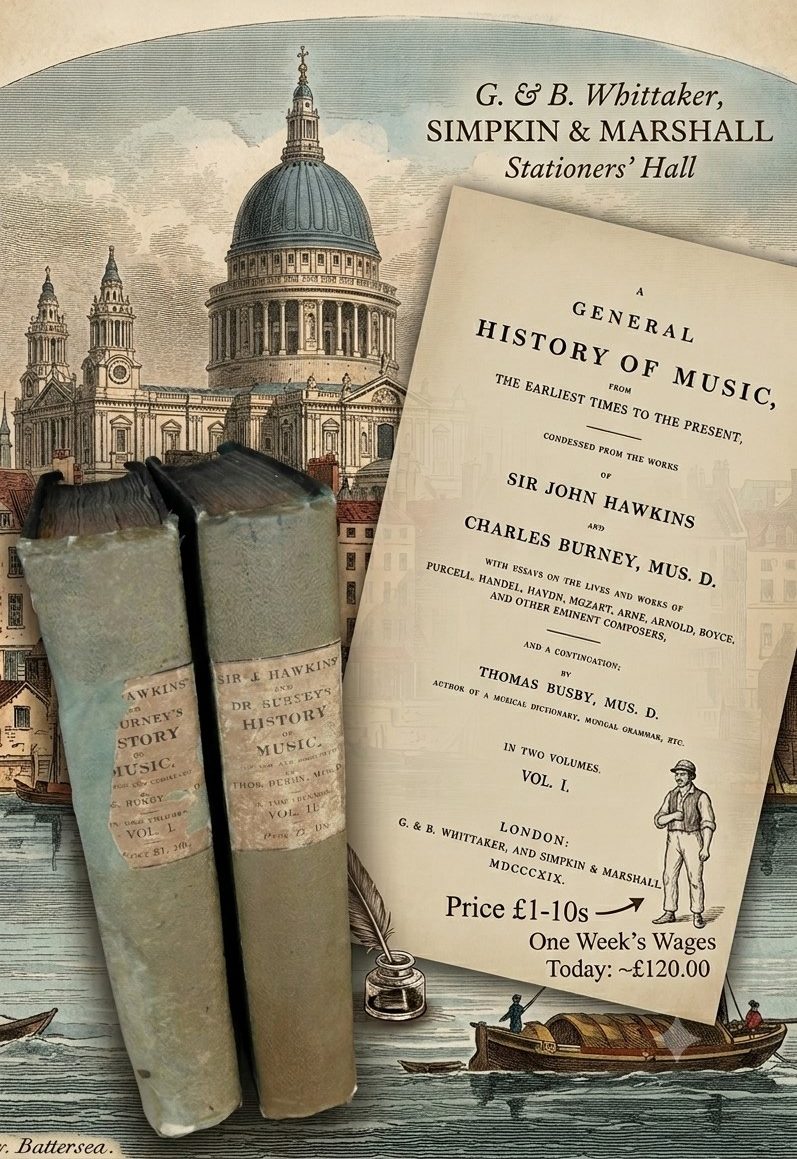
I have on my shelves an original 1819 edition of the grandly titled Sir J. Hawkins and Dr. Burney’s History of Music, reduced and continued by Thomas Busby, Mus.D, in two volumes. You can see it on the illustration, above.
I’ve been intrigued to investigate this fascinating piece of literature from Regency London. By then, the capital was functioning as a modern city, fuelled by the spoils of high finance and the industrial revolution, and calmed by the relative peace following the Napoleonic Wars. Moreover, the monied middle classes were able to access an increasing number of public concerts, and so were curious to discover more about the music they were listening to.
The publication’s title page recto (see illustration) carries a verbose description of the book, typical for its time. You’ll notice that the spine still has its original paper label which carries the price tag of £1-10s (that is, one pound and 10 shillings, when there were 20 shillings to the pound, and 12 pennies to the shilling).
The Bank of England’s inflation calculator reveals that these two volumes would, in today’s money, cost around £120.00. Books were astonishingly expensive then, when one considers that an adult male mill worker earned no more than 30 shillings a week. In other words, he could have exchanged an entire week’s wages for a book on music. However, the poverty of the time never touched the rarefied environments and the people who launched this particular History of Music.
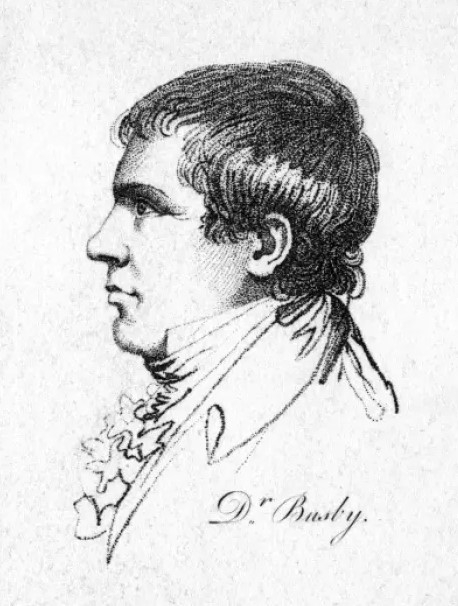
Thomas Busby, who “reduced and continued” the Hawkins and Burney tomes, was a minor composer, organist, writer on music, and journalist. Sir John Hawkins’s A General History of the Science and Practice of Music was published in 1776, the same year as his arch-rival Dr. Charles Burney’s A General History of Music from the Earliest Ages to the Present Period.
Like Busby, Hawkins’s name is now hardly known, although he was tremendously well-connected and respected in his day. He knew Handel, and wrote a biography of Dr. Johnson. Burney’s book generally superseded that of Hawkins, and as well as being the father of novelist Fanny Burney, he’s still remembered as a respected man of letters.
Busby’s aim was to condense the earlier reference works, totalling some nine volumes, into two, while adding further material on Purcell, Handel, Haydn and Mozart. He compiled it whilst living in Battersea (archival investigation might reveal the exact address), then a comfortably affluent and relatively rural enclave.
Down the river by about five miles, were the offices of the book’s well-known co-publisher, G. & B. Whittaker, situated in the shadow of St. Paul’s Cathedral, and adjacent to Stationers’ Hall, the centre of London’s publishing industry. Some things, thankfully, don’t change, and though G. & B. Whittaker ceased trading in the early 20th century, Stationers’ Hall and St. Paul’s are still there in their 17th century grandness.
Simpkin & Marshall were the other publishers or, as seems likely, the distributor on behalf of Whittaker. Based in Stationers’ Hall itself, Simpkin & Marshall were a major book wholesaler and distributor, surviving until the 1950s.
The remaining players in the story of this antique History of Music are its printers, Barnard and Farley, housed close to both publishers at what was 57 Skinner Street, approximately where Holborn Viaduct is today. In fact, quirkily, it might be more or less where Amazon’s corporate headquarters are now. These printers were, at that time, high profile, producing a vast body of literature for the major publishing houses.
Original editions of the book can still be found via antiquarian booksellers, often in better condition than the one I possess. A modern facsimile edition was published by Cambridge University Press in 2013, reproducing the pages of earlier editions. It’s lovely to know that this book is still readily available.
Hawkins and Burney were no longer alive when Busby condensed their books. I doubt whether Burney in particular would have looked favourably at such a project, which combined his respected book with that of his rival, Hawkins. But far from being a hatchet job, Busby’s compilation became an established reference work, more easily digestible than the volumes he based it on. Accusations of plagiarism at the time proved unfounded, as he repeatedly acknowledges, and is generous about, the importance of the Hawkins and Burney scholarship.
Some of the historical conclusions reached by Burney, Hawkins and Busby might seem rather dubious from today’s perspective. After all, it wasn’t really until the middle years of the 20th century that we gained a fuller understanding, via the relatively recent discipline of musicology, of music from the ancient world or from the Middle Ages. For all of this, however, it’s a thorough book, and Busby’s prose is lively.
There are some wonderful curios en route. Busby tells us that “in his oratorios” Haydn’s failure was “almost total”, and that “vocal music, however, was neither the natural forte nor the natural bent of Haydn”. In 1819, Haydn’s music was still relatively new, with the composer having been dead for only 10 years and, to be truthful, the great Haydn revival wasn’t to happen until well into the 20th century.
Busby’s context differed fundamentally from ours: although Beethoven was, in 1819, arguably Europe’s most famous living composer, he receives just one mention in more than a thousand pages, and even then, only alongside long-forgotten contemporaries. Beethoven, writes Busby, “has sweetened science with the suggestions of a strong and lively fancy….” Well, fancy.


What do you think? Comment and/or leave a reply.