What links a 1990s TV cooking show, a hidden sheet music score, and a “cobbler’s patch” of a tune? Discover how Beethoven took Anton Diabelli’s unremarkable waltz and transformed basic ingredients into the ultimate hour-long musical feast.
Do you remember the original television series Ready Steady Cook? I’m not talking about the more recent celebrity version, but the flagship show that aired for a dozen or more years from the mid-‘90s. Chefs were tasked with concocting a meal using a random selection of ingredients usually costing no more than £5.00.
Talented and imaginative participants turned, for example, the given turnip, lemon, carton of sour cream and a fillet of cod, into a gourmet’s delight, whereas the less talented would produce something which merely filled the proverbial gap. Mind you, back then, a fiver was an item; today’s equivalent is around £12.00.
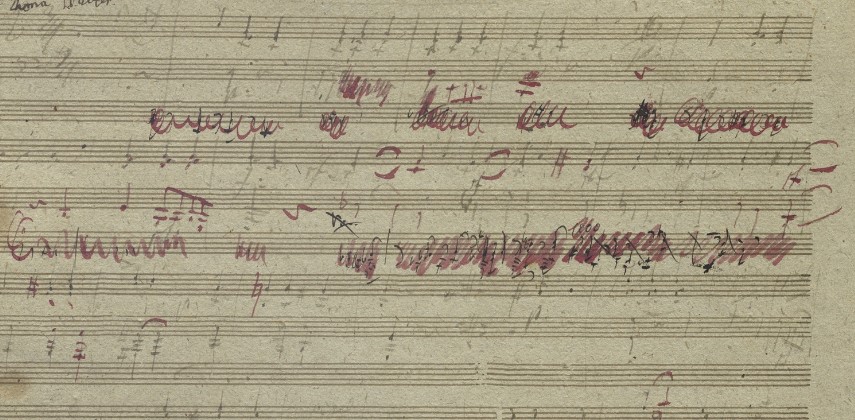
I thought I had mislaid it, but a couple of weeks ago, my cherished and much-thumbed Edition Peters copy of Beethoven’s Diabelli Variations resurfaced, hidden between two large cookbooks, hence my food-related musings. I recalled Ready Steady Cook when perusing Beethoven’s score, for he turns Anton Diabelli’s silly waltz into something quite extraordinary, satisfying all levels of musical hunger.
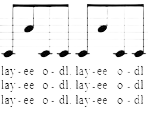
The story is well-known. Composer and music publisher Diabelli commissioned a number of composers to each write one variation on his original waltz, so that the resultant variations could be published in one volume. There are various explanations as to why and how Beethoven decided, between 1819 and 1823, to compose 33 variations rather than just the one. But the true reason lies somewhere between Beethoven’s eye on the prize – i.e., 33 variations being more commercially viable than just one – and the challenge of making decent music from a ‘cobbler’s patch’, as Beethoven himself described Diabelli’s tune.
The variations by other composers, including Franz Schubert and the 11-year-old Franz Liszt, are now largely ignored and, quite frankly, second-rate compared with Beethoven. Schubert’s one variation is thoroughly charming, even if it suffers from some metrical inertia. Liszt’s is terrifically good fun, and Johann Nepomuk Hummel’s and Carl Czerny’s have some formulaic craft to them.
Beethoven’s landmark set, on the other hand, is legendary, known simply as The Diabelli, just as Bach’s Goldberg Variations, which Beethoven was familiar with, are referred to as The Goldbergs. The two sets of variations, separated by some 80 years, are invariably spoken of in the same breath, acknowledged as, arguably, the greatest variations ever penned. The names of Johann Gottlieb Goldberg and Anton Diabelli are perpetuated through these works, rather like the mysterious ‘Mr. W. H.’ who lives on only because he’s the dedicatee of Shakespeare’s 1609 Sonnets quarto.
The journey Beethoven takes us on in his immense set of variations is a strange one. For one thing, with all the repeats observed, the complete work runs for the best part of an hour, and remains one of the longest, and most challenging, solo piano works in the regular repertoire. Yet I defy anyone to feel as if an hour had passed. If time drags, then there’s been a miscalculation on the part of the pianist who has failed to grasp Beethoven’s architectural sweep and in-built momentum. Here, Beethoven achieves his unique sense of dynamic direction, of embarking on an expedition whereby momentum is achieved through structural and harmonic pacing in order to arrive at a musical destination.
Were one to play Diabelli’s waltz immediately followed by, say, the highly embellished, lengthy and slow C minor Variation 31, or the cerebral E flat fugue of Variation 32, one’s head would be well scratched at fathoming exactly how the composer reached this stage. But listened to in context from the beginning, when these variations arrive after 50 minutes or so, the transformation seems natural, indeed wondrous. Consider, too, the sepulchral, rhythmless Variation 20 with its harmonic false relations and juxtapositions, and marvel at the fact that this solemn music is, somehow, related to the ‘cobbler’s patch’.
The final variation is a minuet, so that Beethoven’s starting point of a common waltz, some 60 minutes earlier, now becomes something more courtly, more refined. But even within this variation, the minuet is gradually transformed from the dancefloor to something quite different: highly embellished, high tessitura with bell-like sounds, ever upwards, touching Heaven. As Wilfrid Mellers puts it in Beethoven and the Voice of God (1983): “So Beethoven-Prometheus is an intermediary between man and the gods.” Thus, Beethoven’s transformation turns Diabelli’s “trumpery waltz into a celestial, not merely aristocratic, minuet.”
This was Beethoven’s final large-scale solo piano work, as he had put the canon of 32 sonatas to bed a year earlier in 1822. There would be a handful of shorter pieces, including the delicious Six Bagatelles of 1824.
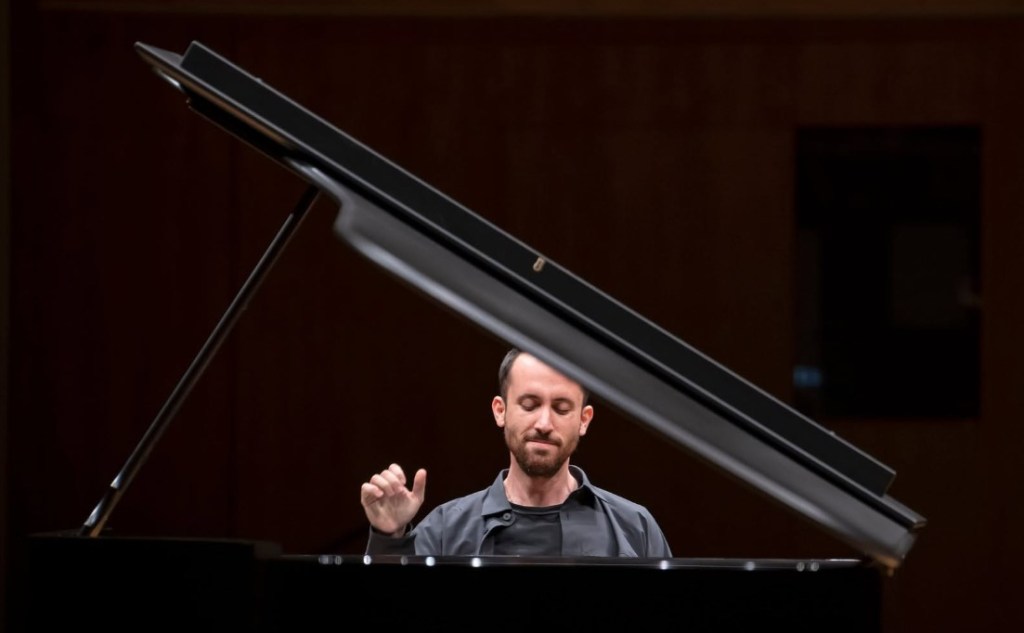
The Diabelli boasts countless fine recordings, but I especially admire Igor Levit’s 2015 reading. For my money, Levit is one of the outstanding pianists of our age. He eschews bravura in a Diabelli performance which is so beautifully balanced, that Beethoven’s final variation, that postlude homage to the bygone age of the minuet, emerges naturally. The organic unity of Levit’s performance allows each variation to not only grow from the previous one, but to follow what I believe are Beethoven’s intentional, though never explicitly stated, larger sub-sections within the whole.
Anyhow, it’s gorgeous, elegant, exciting, and homogenous playing, with no sentimentality or extreme thumping fortissimos. Levit knows that you don’t need to over-egg the pudding that Beethoven ingeniously concocts from the paucity of Diabelli’s ingredients, in order to capture and convey Beethovenian integrity and vision.


What do you think? Comment and/or leave a reply.