Think Haydn’s Farewell Symphony was just a polite joke to get musicians home to their wives? Think again. Here is Part 1 of an investigation into the dark, coded truth behind a masterpiece.
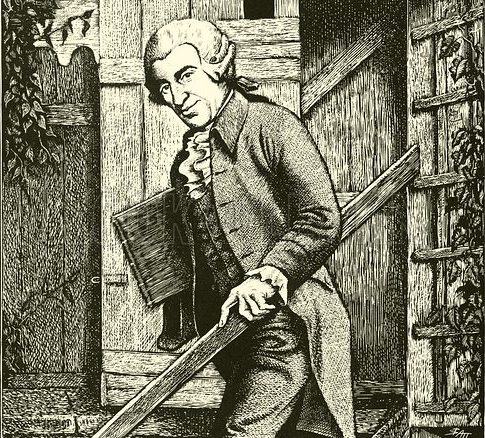
The catalyst for this article was a recent concert I attended which included Haydn’s well-known Farewell Symphony (No. 45). And thereby hang two tales. One is the ‘received’, popular version. The other is… well, you can judge for yourselves.
In the late 18th-century, from the 1770s until his death in 1809, Haydn’s music and his name were revered, serving as a huge influence on both Mozart and Beethoven, to name just two. It’s hard to imagine that not long after his death, and for over a century, Haydn’s music fell out of favour. The Victorians, who loved a suffering hero like Beethoven or a ‘divinely inspired’ Mozart who died under mysterious circumstances, had little time for “Papa Haydn”, this apparently genial guy who wrote pleasant music.
Felix Mendelssohn tried to rehabilitate his music in the 1830s, but even Mendelssohn’s friend Robert Schumann thought that it was a waste of time. What we now consider to be that warhorse of oratorios, Haydn’s Creation, wasn’t commercially recorded until 1949, and recordings of the symphonies were few and far between until after the Second World War.
Similarly, and strange to think, concert programmes were hardly awash with Haydn’s music around 70 years ago. Since then, there’s been an immense amount of Haydn scholarship, helped immeasurably on its way by post-war musicologists such as Karl Geiringer and his student H.C. Robbins Landon. More recently, musicologists such as James Webster (1991), Gerhard J. Winkler (1996), Thomas Tolley (2001), and Kevin Korsyn (2009), have waded in with fascinating insights into Haydn’s music, and the Farewell in particular. Their research has helped inform this article.
To give you an idea of Haydn’s neglect and the facile way in which his music was discussed, Peter Gammond, in his attractive 1968 book The Meaning and Magic of Music, describes Haydn as:
“…very pleasant and easy-going, with none of the fiery poetical temperament of the typical ‘romantic’ writer, and his music is very like his character. Although it has a few stormy moments, it is mainly calm and balanced with a touch of humour.”
And reading the 1970 edition of The Oxford Companion to Music (which, essentially, is the same text as the 1938 first edition, but with more editorial control), you’d never guess that Haydn was one of the great innovators and pioneers, though it laments the fact that, at that time, too few of his works were available in print.
The story of the Farewell Symphony is well-known enough, and goes something like this. Haydn was employed at the Austro-Hungarian Court of Esterházy for 30 years from 1761 to 1790, essentially as head of music. In 1772, his boss, Prince Nicholas Esterházy, was resident, together with all his musicians and retinue, at his favourite summer palace at Eszterháza in rural Hungary. The stay there had been longer than expected, and most of the musicians, all of them men, had been forced to leave their wives back home at the Prince’s other estate in Eisenstadt, in modern-day Austria, about a day’s journey away.
Longing to return, the musicians appealed to their Kapellmeister, Haydn, for help. The diplomatic Haydn, instead of making a direct appeal to the Prince, put his request into the music of the symphony: during the slow final section, each musician stops playing, snuffs out the candle on his music stand, and leaves in turn, so that at the end, there are just two muted violins left. The Prince seems to have understood the message, because the court returned to Eisenstadt the day after the performance.
This version of events fits received notions about Haydn. Good-natured, affable Papa Haydn, as he is often referred to, with fatherly care for his musicians, sending a jokey musical message to his pal, the Prince. “Good ol’ Haydn,” the Prince must have thought. “What a wag. Of course the musicians must go home to their wives. Whatever was I thinking?”
Except, I don’t think it was quite like that.
The fourth and final movement of the symphony is very curious, not only because the musicians disappear, but because it begins as a typical rapid Haydn Presto finale, stops suddenly, and ends slowly, Adagio, with its farewell conclusion which is longer than the preceding Presto. This slow final section is more-or-less a movement in its own right, and in fact I propose that the symphony is essentially in five, rather than four, movements because it’s no mere jokey add-on in my view, but altogether more thoughtful.
This final Adagio is a minuet and, as with all minuets, in triple metre. The first, second and third movements—the third is, following convention, also a minuet—are also in triple metre. So apart from three minutes of duple metre Presto which opens the fourth movement, triple time occupies roughly 90% of this work.
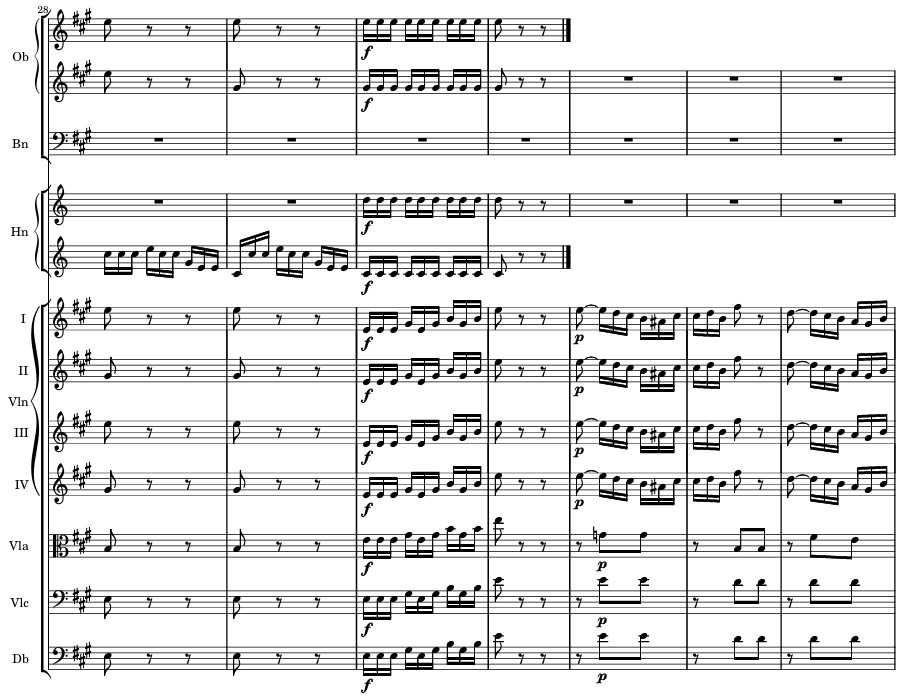
Then there’s the key of the symphony, F-sharp minor, the only 18th-century symphony in this key (I think), and the work ends in what’s known as the tonic-major, the rarely used key of F-sharp major. So rare was F-sharp major or minor in orchestral music in the 18th-century that Haydn had to procure special instruments for his horn players that would allow the valveless horns of that time to tackle that tonality.
We have, then, a number of features which place this symphony within the realms of the experimental. Whichever Esterházy palace Haydn found himself in, he was isolated from the big city. He said: “I was cut off from the world; nobody in my vicinity could upset my self-confidence or annoy me; and so I had no choice but to become original.” In other words, he turned his situation into an opportunity, rather than just a cushy number.
The other thing we have to consider is Haydn’s personality. Contemporaries attest to the fact that he was generally even-tempered and never less than sensitive to the needs of others. The term Papa Haydn was coined when the composer was in his dotage, the last three years of his life spent in physical and mental deterioration. Beyond this, however, and despite him being portrayed as somewhat benign, there was a steely resolve, hardly ever discussed or documented, which shows him to be totally ruthless and utterly focused when it came to musical excellence and his compulsion to experiment. And without this level of compositional innovation, there is no doubt in my mind that the music of Mozart and Beethoven would have turned out very differently.
So with this in mind, I share with you the thought that Haydn’s use of tonality and metre in this symphony was far from whimsical. Haydn was deeply religious, and the number three writ large in this symphony—a proliferation of triple metre, key signatures with three sharps—is worthy of further investigation, especially since nothing—absolutely nothing—in Haydn’s music is arrived at by mere fancy.
Thomas Tolley and James Webster have separately discovered a fragment of a hymn melody, originally derived from a Gregorian chant, in the symphony’s middle section of the third movement. Tolley has found a similar melody, actually labelled as such by Haydn himself, in the Symphony No. 26, known as Lamentatione, composed in 1769, three or so years before the Farewell Symphony.
Looking at the Lamentatione Symphony, there are similarities between it and the Farewell. For example, it’s also in a minor key (D minor), the number three plays out in its three-movement structure, and the final movement is a minuet. The religious element is to the fore, as the title (though it’s not one that Haydn gave it) is derived from the fact that the work was written for Holy Week and Easter, and the plainchant melody that I mentioned a few moments ago is none other than one used during Tenebrae services at Easter. The audience at the time would have recognised this.
Heaven forfend that anyone should use Wikipedia when engaged in research, but a surreptitious search will tell you that: “Tenebrae is a religious service of Western Christianity held during the three days preceding Easter Day, and characterised by gradual extinguishing of candles.” That Haydn’s Farewell Symphony (and he didn’t give the work that title, either) ends by this gradual extinguishing of candles, and that Tenebrae is the Latin for darkness, suggests that the work goes far beyond a mere plea from musician to prince for homesick instrumentalists to be allowed to be reunited with their spouses, though this part of the story shouldn’t be forgotten.
Join me next week for Part 2, where we’ll step into our musical time machine to unravel the court politics, the strict moral codes, and the sheer theatrical audacity of the symphony’s premiere.


What do you think? Comment and/or leave a reply.