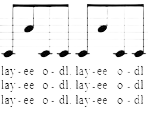
When Charlie Parker quoted The Firebird to a listening Stravinsky at Birdland, it wasn’t just a clever stunt. It was the meeting of two revolutions: the moment classical music’s boldest modernist officially crossed paths with the pulse of jazz.
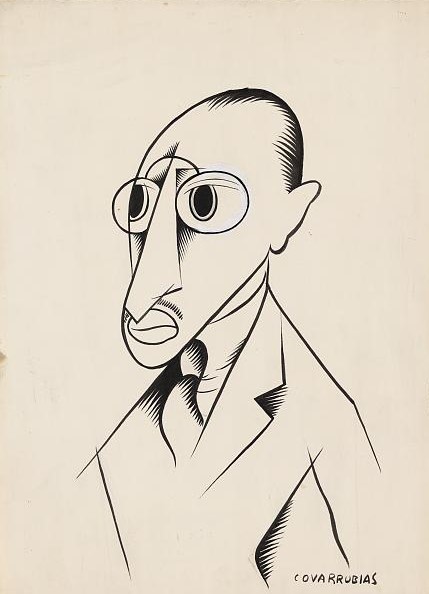
Three dates.
1882, the year of Igor Stravinsky’s birth: if you wanted to travel from London to New York, you’d have had to endure an Atlantic crossing by ship, taking around seven days, plus a train journey from London to Southampton.
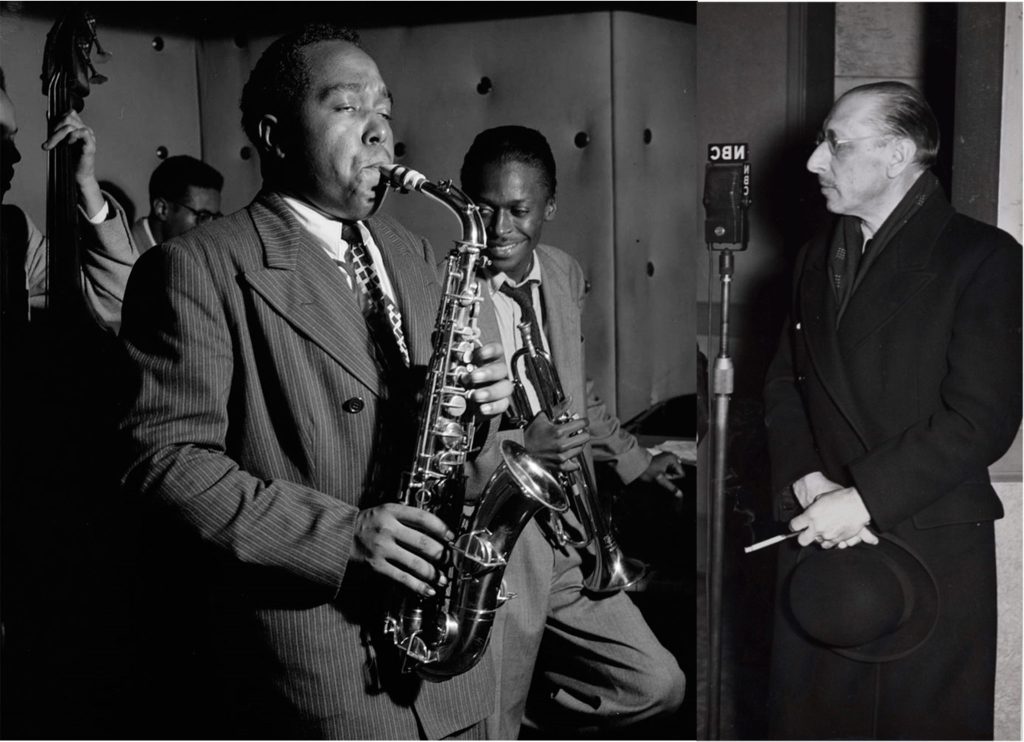
1951: Stravinsky stepped into Birdland, the hallowed temple of New York jazz. Observing from the crowd, he watched the great saxophone virtuoso Charlie ‘Bird’ Parker spontaneously quote the opening phrase of Stravinsky’s Firebird ballet right in the middle of a solo on his 1945 bebop staple, Koko.
1971, the year of Stravinsky’s death: if you wanted to travel from London to New York, you’d catch a jet plane from Heathrow Airport at breakfast time, and be in New York for a second breakfast seven hours later. Which, according to your watch, was only two hours after you left Heathrow.
These dates and events remove Stravinsky from his native Russia of almost 150 years ago, to the modern age and all its trappings. In his final years, he literally jetted around the world. Take a snapshot of a few weeks in 1964, by which time he was in his 80s: May in Toronto, Detroit, Philadelphia; June in New York, Denver, the UK (London and Oxford); July in Hollywood, Chicago, Santa Fe; August in Paris, then Israel (Jerusalem and Caesarea); September in Berlin, back to Paris, back to New York.
There were, of course, no jazz clubs in 1882 when Stravinsky was born. There was no jazz. But by the time he heard Charlie Parker pay homage to him in that Manhattan club, Stravinsky’s ragtimes were more than 30 years old, and he’d already written a jazz combo concerto for Woody Herman’s band.
The Charlie Parker encounter is, I contend, of far more significance than Stravinsky’s encounter with another famous person, his affair with the most celebrated fashion designer of the last century, Coco Chanel, though one of the alleged outcomes of the illicit affair is supposed to be the famous Chanel No. 5 perfume.
Be that as it may, and though we can stroll into our local John Lewis and purchase a bottle of the famous fragrance, I’d much rather have a recording of Parker’s Firebird improv. Sadly, one doesn’t exist. But what’s well documented, is that Stravinsky was so ecstatically thrilled by what he heard at Birdland, that his glass of liquor and ice ended up being hurtled, good naturedly, amongst the audience.
Anyhow, that improvisation in New York wasn’t as unusual as you might think. In Paris, May 1949, Parker performs a number called Salt Peanuts, quoting the opening of that other celebrated Stravinsky work, The Rite of Spring. Later, in February 1953 in Washington DC, Parker performs Fine & Dandy, this time quoting the trumpet solo (the Ballerina’s entrance) from Stravinsky’s Petrushka. Earlier, Neal Hefti’s 1947 arrangement of Parker’s Repetition references the ‘Augers of Spring’ from The Rite of Spring.
So these are all notable jazzy tributes to Stravinsky, arguably by the 1940s the most famous living modern composer. One of the reasons for such fame was due to another manifestation of the modern era. In 1940, Disney Studios released the animated film Fantasia, part of which featured The Rite of Spring against a background of prehistoric scenes. It remains one of the highest grossing films of all times in terms of box-office returns, and so it did Stravinsky’s legacy and his bank balance no harm whatsoever.
Those composers of concert music who were directly influenced by Stravinsky – and the list includes almost every composer born from the 1880s onwards – easily demonstrate just how far-reaching and long-lasting Stravinsky’s legacy is. And not just concert music, but film music, too. Where would, for example, the John Williams soundtracks be without their frequent references to Stravinsky, especially The Rite of Spring? But Stravinsky’s influence on the non-classical is often overlooked, and Charlie Parker is just one example, though perhaps the most significant simply because of Parker’s hallowed place within his world.
But what about jazz influencing Stravinsky? It’s interesting to ponder that the birth of The Rite of Spring in 1913 is more or less contemporaneous with the birth of New Orleans jazz in the early 1910s, though ragtime and cakewalk can be traced back to the 1890s, with early incarnations of Dixieland and blues following on. When you think of it, Stravinsky’s unprecedented use of rhythm in The Rite of Spring, where rhythm, rather than melody, becomes the foreground of the music, is something of a natural bedfellow with jazz, and that didn’t go unnoticed amongst later jazz musicians.
Stravinsky composed three ragtimes between 1918 and 1919, rags in rhythm, though not in harmonic structure. And from then on, composers of concert music frequently dabbled in jazz-like idioms in their works, especially in the 1920s, whether it was Ravel’s acutely refined Blues in his Violin Sonata, or various works by Darius Milhaud, or works by the Czech composer Erwin Schulhoff, or the astonishingly pioneering concert music of George Gershwin.
So by the time Stravinsky composed his Ebony Concerto in 1945, this idea of combining jazz with concert music wasn’t new. But I contend that the Ebony Concerto really is something different, and was to have a far-reaching impact.
Gershwin’s concert music is heavily reliant on styles taken from show-tunes and blues, and as he was a songwriter of rare talent, melody is all-important. When he was commissioned to compose Rhapsody in Blue for Paul Whiteman’s so-called ‘An Experiment in Jazz’ concert at New York’s Carnegie Hall in 1924, both composer and bandleader were making a conscious effort to bring jazz into mainstream concert music. And though it could be argued that Rhapsody in Blue isn’t Gershwin’s finest piece, it makes a point as marking a watershed in 20th century music.
Whiteman’s musicians took Gershwin’s score in their stride, unlike the musicians in Woody Herman’s band. They were challenged with Stravinsky’s language in the Ebony Concerto because this work was quite unlike any other jazz-classical crossover piece so far.
The American jazz clarinettist, saxophonist, singer, and big band leader Woody Herman was a towering figure in his field in the 1930s and ‘40s, though he and his band (which had various incarnations and names) continued to perform until his death in the mid-1980s. His name continues with the present-day Woody Herman Orchestra, so immense was his influence.
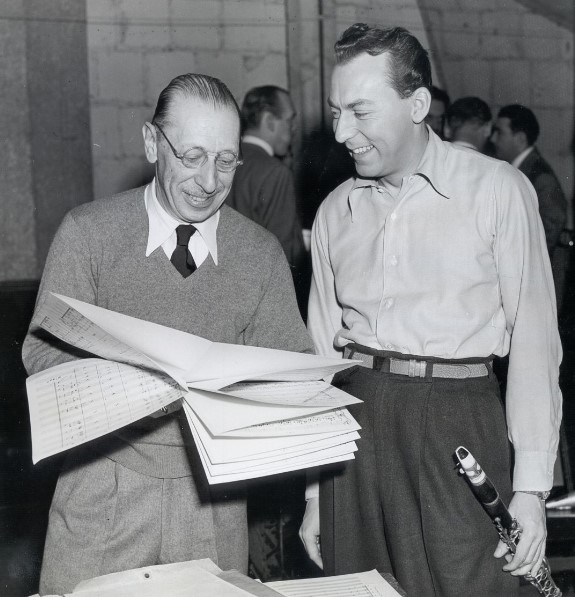
It’s said that Herman’s number Caldonia was the initial influence for Stravinsky to compose the Ebony Concerto, and there’s the anecdote, put across by Herman’s arranger, Neal Hefti, whom I mentioned earlier, that it was the solo with five trumpets, something of a masterstroke from Hefti, which got Stravinsky’s creative juices flowing. In fact, it’s just the sort of aural gesture which would have appealed to Stravinsky, so I think there’s some truth in this.
Stravinsky makes no attempt to write fake jazz. Listening to the Ebony Concerto, it’s clear he isn’t trying to imitate the traditional big band sound. While there are obvious jazz-inflected elements, dictated by the makeup of Herman’s ensemble, Stravinsky knew that authentic jazz was the domain of specialists who did it far better than he ever could.
So this work uses Stravinsky’s default language of his current Neo-Classical period. It’s chamber-like in the way in which it explores different groupings within the ensemble. Like, for example, the earlier Dumbarton Oaks Concerto (1938), or the Concerto in D (1946), it’s something of a 20th century perspective on the 18th century concerto grosso; a 20th century jazz-like Brandenburg Concerto, if you will.
In terms of performances, there’s a particularly fine one with Pierre Boulez conducting the Ensemble Intercontemporain, precise and Classically virtuosic. But compare that to the performance recorded in 1946 with Woody Herman’s band, Herman taking the clarinet solo, and Stravinsky conducting. It might not be as precise as the Boulez, but my goodness it has a raw vibrancy, a jazzy breathiness and reediness, which is wonderful, and so captures the piece.
Stravinsky’s influence cuts across the 20th century and beyond. There’s hardly been a composer during the past 100 or more years who hasn’t been influenced by his style and idea. For me, I find the intensity of his craft breathtaking and fascinating. If I were to single out just one piece which I think is most closely aligned to the Ebony Concerto, it would be Leonard Bernstein’s Prelude, Fugue and Riffs.
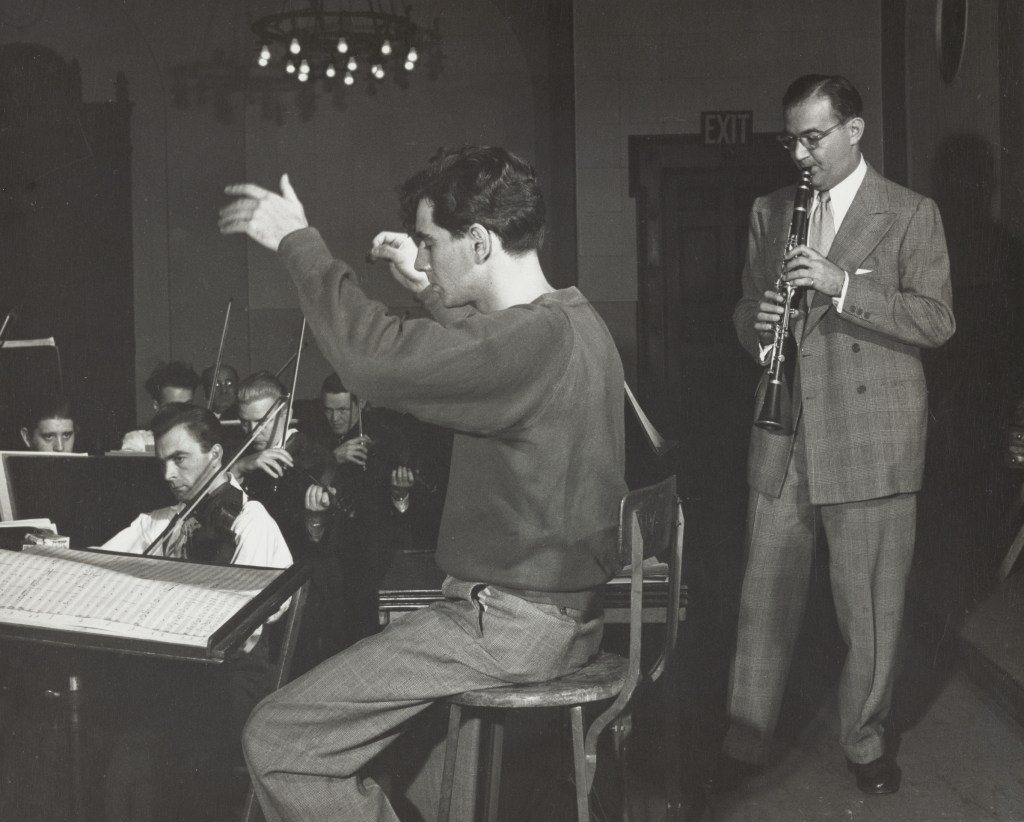
This was originally composed for Woody Herman’s band in 1949, with the solo clarinet taking the lead. But the band in its previous incarnation had disbanded, and so the dedication was transferred to perhaps the most famous jazz clarinettist of them all, Benny Goodman. Bernstein revised the piece, and it was finally premiered in 1955 on Bernstein’s television programme, Omnibus, with Al Gallodoro, not Goodman, as the clarinet soloist.
In titling the piece, Bernstein uses terms which we normally associate with classical music, not least Baroque music. Stravinsky’s work, as I previously mentioned, is a type of latter-day concerto grosso, and in Bernstein’s use of the terms Prelude and Fugue, it certainly acknowledges the Baroque tradition. Adding the word ‘Riffs’ is in itself something of a subversive masterstroke. Listening to the opening of Bernstein’s exciting piece, you can clearly hear that his starting point was the Ebony Concerto.
Stravinsky died in April 1971. As a homage, on the first anniversary of Stravinsky’s death, Bernstein presented what for me is the best ever 10-minutes worth of Stravinskian evaluation.


What do you think? Comment and/or leave a reply.