This week, we prepare for Remembrance Sunday on 8th November, and we’ll mark Armistice Day on Wednesday. I’ve been thinking about music which has been directly informed by war. Over the centuries, there’s been no shortage of compositions which have reflected on, and responded to, the horrors of war in various ways, but my focus here is Edward Elgar’s For the Fallen.
On 15th August 1914, Elgar’s Sospiri (Sighs), a short work for string orchestra, harp and optional organ, was first performed. It languished in relative obscurity until fairly recently, though even now, inexplicably, it’s an infrequent visitor to the concert platform. It’s been suggested by countless commentators who happily ignore the evidence that Sospiri’s reflective mood matched the general feeling of the time, with the Great War having kicked off a few days before the premiere. But Elgar had completed the piece back in February, so there really is no connection. One of his working titles for it was Absence, so, in a way, it does have that sense of loss. But whatever, or whoever, was behind Elgar’s first title – we simply don’t know – it remains one of the composer’s most poignant and heartfelt pieces.
But war did come, and I can’t help feeling that this catastrophe, in a sense, marked the slow beginning of a long end for this great composer. War was declared ten days after the premiere of Sospiri, and the 57-year-old Elgar volunteered as a special constable for Hampstead to take the place of younger men who had gone to fight. It’s a job he did with the utmost keenness. In early 1915, he joined the Hampstead Volunteer Reserve, complete with new uniform and rifle practice. His zeal wasn’t the stuff of a middle-aged man attempting to capture a sense of derring-do. Rather, the war affected him profoundly.
This is oft-quoted, but here he is writing to his friend Frank Schuster on 25th August 1914 (I have preserved Elgar’s quirky punctuation):
“Concerning the war, I say nothing – the only thing that wrings my heart and soul is the thought of the horses – oh! my beloved animals – the men – and women can go to hell – but my horses; – I walk round and round this room cursing God for allowing dumb brutes to be tortured – let Him kill his human beings but – how CAN HE? Oh, my horses.”
The collection of essays Oh, My Horses! Elgar And The Great War (Elgar Editions, 2001) edited by Lewis Foreman, with an accompanying CD, looks specifically at how the conflagration impacted on the composer and his creativity.
He was also homesick for his native Worcestershire. Here he is writing to his Worcester-based friend Ivor Atkins in November:
“If it is sunshiny, just go round to the west end of the Cathedral and look over the Valley towards Malvern – bless my beloved country for me – and send me a postcard saying you have done so.”
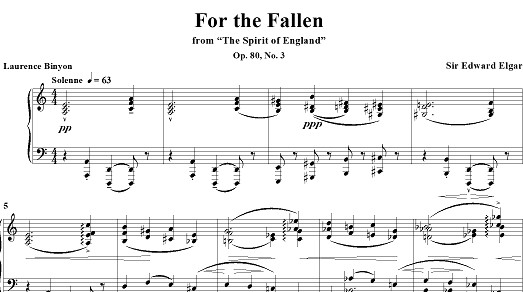
Elgar composed a number of pieces for the war effort, or as a response to the war. These include Carillon (1914), Une voix dans le desert (1915), and Le drapeau belge (1917), all with words by the Belgian poet Émile Cammaerts. But his most ambitious achievement is the choral work For the Fallen, a setting of Laurence Binyon’s words from 1914, and part of a trilogy of works titled The Spirit of England. For the Fallen isn’t a call to arms, or a battle cry, but a reflection on the terrible toll of war, with words that are familiar to all of us:
They shall grow not old, as we that are left grow old:
Age shall not weary them, nor the years condemn.
At the going down of the sun and in the morning
We will remember them.
Do a YouTube search on these words, and you’ll discover that they’re usually backdropped against Elgar’s famous ‘Nimrod’ melody, thereby sentimentalising the impact of the words. The point is, that Elgar didn’t want his music to submerge what’s already strong verse. So when he sets the words, you’ll notice the unstable harmonies, and the angular and wide-ranging melodic shape of the soprano’s interjections. It’s a lament, and it’s unsettling, and to consider this music as being sentimental, or merely patriotic, would be to underestimate what Elgar was doing. I don’t feel there’s any consolation, but I do feel it’s troubled music, forming part of what I would describe as Elgar’s own War Requiem.
There was no lack of commitment on Elgar’s part to contribute to the war effort. But it took its toll, not only the heartbreak he felt because of the horrendous carnage, but that concert life during a four-year period had almost come to a close. 1916 saw him compose just two short works, and there was nothing composed during the war which was symphonic in scale.
In 1918, he composed the Violin Sonata, String Quartet and Piano Quintet, all of them fine and compelling works, but they’re so rooted in the language of, say, Brahms and the 1870s, that it’s easy to forget that Stravinsky’s Rite of Spring, Bartok’s Bluebeard’s Castle, Schoenberg’s Erwartung, or Richard Strauss’s Salome had already been composed. As if the public wanted the new, rather than the old, in this post-war age, the 1919 premiere of the Violin Sonata, and a subsequent Birmingham performance, were given in venues with too many empty seats. But that’s a story perhaps for another time.
In the meantime, as we head towards Sunday’s events throughout the land, we contemplate on the immense sacrifice of those heroes who fought for our freedom.


What do you think? Comment and/or leave a reply.