Beethoven’s Symphony No. 6 in F major, Op. 68, the Pastoral, is a fascinating work, which might seem like a strange thing to say given that it’s one of the best-loved symphonies of all time, hugely popular with more than 500 commercial releases currently available. Its appeal lies in the pictorial nature, with movements bearing descriptive titles, and tunes that we can all readily hum. On the surface, it’s decidedly pleasant and seems to be an undemanding listen. We get birdsong, dance music, a rowdy storm, and a shepherd’s song. To be uncharitable, it could be described as Beethoven at his most twee, his most slick. Yet why is it such an intriguing piece?
Part of the answer is that it’s not quite what it seems; it invites reading on multiple levels. The listener is guided—assisted at best, manipulated at worst—by fanciful movement titles such as Scene by the brook, Peasants merrymaking, and Thunderstorm. In truth, these titles aren’t strictly prescriptive, because Beethoven explicitly notes that the symphony is “more the expression of feeling than painting.” We can say that the work relies less on concrete depiction or narrative than on conveying emotion directly.
Beethoven worked on the Pastoral alongside his Fifth Symphony between 1807 and 1808. Both were premiered at the same concert in Vienna in 1808 and published by Breitkopf in Leipzig the following year. This phase of Beethoven’s output is often referred to as his Middle Period, or more specifically his Heroic Period, a term coined by his biographer Romain Rolland in 1903 and subsequently adopted by others. Works such as the Eroica, Fifth, and Seventh Symphonies, the three Razumovsky String Quartets, the Waldstein and Appassionata Piano Sonatas, and the Kreutzer Violin Sonata all belong to this framework, and looking at those scores, we can understand where Rolland was coming from. At any rate, the label has stuck.
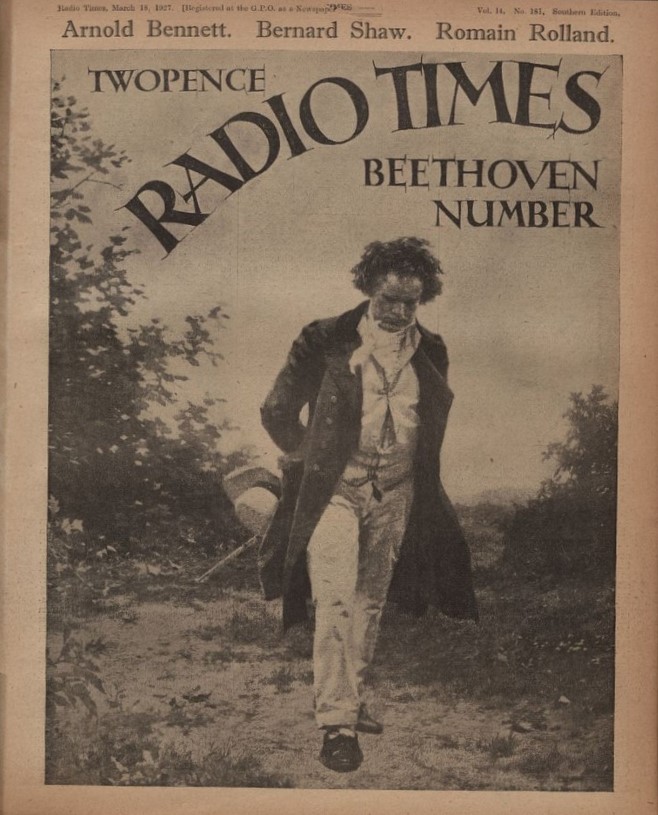
But is the Pastoral heroic? Is it, like its companion piece the Fifth, a night-to-light journey? Does it stride out like the Eroica, or carry a political subtext like the opera Fidelio? Well, no. The term heroic is only partially appropriate here. Many works from this era challenge the heroic aesthetic entirely or adopt it only in part; think of the intense lyricism of the Fourth Piano Concerto, for instance. In J.W.N. Sullivan’s landmark 1927 study, Beethoven – His Spiritual Development, the Pastoral becomes something of an inconvenient truth. Written during an era that molded Beethoven into the archetypal suffering hero, Sullivan’s book dwells extensively on the other Heroic Period works while seeming entirely unsure what to make of the Pastoral.
Perhaps it was the programmatic movement titles that troubled Sullivan. Yet we cannot ignore the apparent contradiction between those descriptive headings and Beethoven’s caveat about “more the expression of feeling.” In the popular culture of the day, there was a steady appetite for descriptive music. Indeed, in the second movement, Beethoven goes so far as to write in the specific names of the cuckoo, quail, and nightingale. It’s clear what is happening here, making for an odd bedfellow with the mere “expression of feeling.”
As a marketing ploy, the birdsong was a canny move. As a successful self-employed, freelance composer, if Beethoven didn’t earn money from his music, he didn’t make a living. Yet amongst the musical cognoscenti, descriptive music was frequently dismissed as vulgar. The leading music journal of the day, the Wiener allgemeine musikalische Zeitung, described the subject of Beethoven’s later, hugely popular Battle Symphony (Wellington’s Victory to give its proper title) as “a trifling object for music.” It begs the question whether Beethoven’s “expression of feeling” disclaimer was an opt-out clause designed to appease such critics. Certainly, early sketches suggest that his initial written descriptions for the individual movements were even more detailed.
Another issue is the extent to which the work is truly symphonic. While the term isn’t restricted to symphonies alone, denoting instead complex music that employs intricate compositional procedures, which string quartets or concertos can equally display, the Pastoral remains unlike any other Beethoven symphony. Rather than deploying his usual rigorous techniques of development, his material often relies on repetition, his harmonies lean on drone-like effects, and complex counterpoint is kept to a minimum. Meanwhile, dramatic gestures, such as the abrupt halt of the peasants’ dance as the storm breaks, possess a positively operatic theatricality.
If the Pastoral followed conventional symphonic architecture, the peasants’ merrymaking would function as a traditional scherzo leading directly into the finale. Instead, the fourth-movement Thunderstorm slashes violently across the score. Its ferocity clears the canvas, allowing Beethoven to indulge at length in that glorious final movement when it finally arrives. Without the storm, that finale simply would not work. What Beethoven achieves in the Pastoral is the invention of a new type of symphonic structure, making it just as audacious an achievement as its companion piece, the Fifth Symphony.
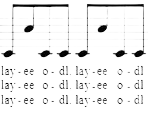
There are clear structural reasons why the Fifth and Sixth Symphonies, despite inhabiting completely different soundscapes, remain companions. Beethoven frequently worked on concurrent projects, and cross-fertilisation between them is common, much like his final Piano Sonata (Op. 111) and the contemporaneous Diabelli Variations, or his final batch of string quartets. Looking at the openings of both the Fifth and the Pastoral, we notice identical rhythmic foundations: 2/4 metre, Allegro, predominantly strings, a quaver rest followed by three quavers, and a concluding pause. One places rhythm firmly in the foreground; the other, melody.
The final bars of the Fifth Symphony hammer home C major, the tonal goal the entire work has aspired toward. The ending of the Pastoral does much the same thing, not eighteen bars of hammering repeated chords, but a radiant celebration of F major. The underlying harmonic strategy is identical, even if the resulting sound is entirely different. Just as we have merrymaking peasants in the Pastoral’s scherzo, we find scheming sprites with their own shadowy dance in the Fifth’s equivalent movement. The parallels extend far beyond these examples.
Often overlooked in the Pastoral is its ingenious orchestration. The standard orchestra of the late 18th century, established by Mozart and Haydn by the 1770s, consisted of double woodwind, pairs of French horns and trumpets, timpani, and strings, a lineup Beethoven rarely reduced.
In the Fifth Symphony, Beethoven expands these forces for the first time to include three trombones, a piccolo, and a contrabassoon, leaving Haydn and Mozart’s sonic world behind in favour of a heavier, grander sonority. The Pastoral’s orchestra is only slightly smaller: two trombones instead of three, and no contrabassoon, though the piccolo remains. Yet this full orchestra is deployed for a mere seven bars out of nearly one thousand five hundred, roughly twenty seconds out of forty minutes.
In the first two movements, there are no trumpets, trombones, timpani, or piccolo. This is pure chamber music. Come the third movement, Beethoven adds a pair of trumpets to enliven the peasants’ dance, but only for around 60 bars out of more than 450. It is only in the fourth-movement Thunderstorm that he unleashes his full forces, and even then, strictly for the final crashing climax, 106 bars into its 155-bar span. For the fifth movement, the Shepherd’s song of thanksgiving after the storm,the trumpets and trombones remain, but the timpanist and piccolo player are left twiddling their thumbs.
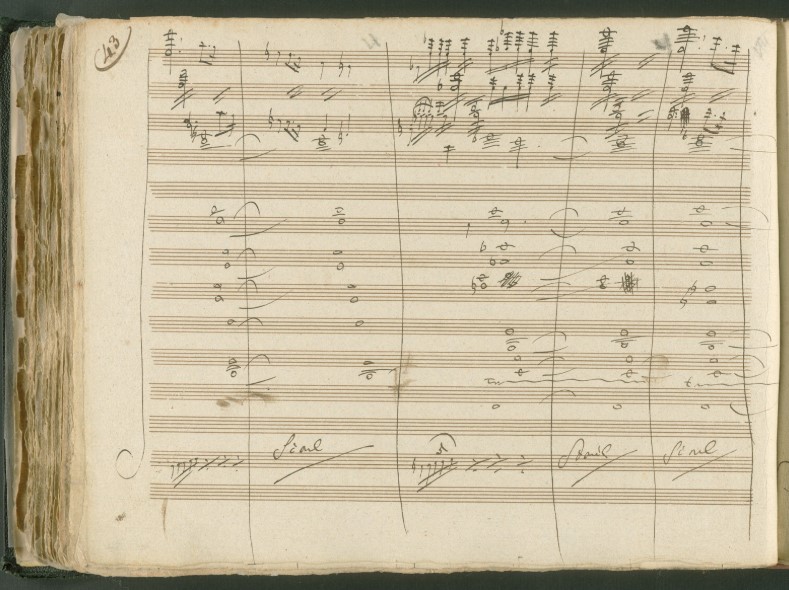
On the subject of orchestration, a brief word should be said about the second movement with its celebration of endless melody (what a masterclass this must have provided for Wagner!). In his string writing here, Beethoven introduces an extra layer: two solo muted cellos. With a modern string section of forty players deploying liberal vibrato, these two instruments are entirely swallowed up. Yet in a historically informed performance using a reduced string band playing period instruments with minimal vibrato, those two cellos add a fabulous, luminous sheen to the texture.
It is also worth noting that in the final movement, Beethoven retains the trombones introduced during the storm. They add noble sonority to the finale, but it feels as though he is reminding us that we have lived through a cataclysmic event. Although the weather has cleared and healing has begun, the ghost of the tempest remains. We cannot undo the past; that great gash of a thunderstorm has left an indelible scar. For me, the storm operates both literally and metaphorically. As in nature, so in life: contentment is always vulnerable to being shattered at worst or interrupted at best. A fracture may heal, but its scar never fades. No composer in history understood the profound dualities of human joy and sorrow quite like Beethoven.
Let us not forget that when this music was being written in Vienna, the city had recently been occupied by Napoleon in 1805. While this first occupation was relatively peaceful compared to later invasions, it left the city, and its greatest composer, feeling profoundly uneasy and vulnerable. Months later, when Beethoven commenced work on the Pastoral, he may well have projected some of that ambient anxiety into the symphony’s darker turns.
In the closing moments of the Pastoral, over gentle string murmurings and a clear, contented F major, the first horn, now pianissimo and muted, recalls the movement’s main theme. It sounds like a distant yodel, almost off-stage, as we bid farewell to the rural idyll and prepare to re-enter the urban sphere. Those gentle string textures, derived from the low growls of the storm, act as an aural, subliminal watermark of the tempest. The music gradually descends, coming full circle to mirror the opening where the music ascended. Finally, two assertive, optimistic chords close the story. It is time to return to work, back to the city. Out with the old, and on to something new.
Beethoven, therefore, does not merely tell a story through melodies and words, whether via movement subtitles or written-in bird calls, but constructs an orchestration so subtle and carefully managed that the sound-world itself becomes part of the narrative, provided we know how to listen.
The Pastoral remains unique in Beethoven’s symphonic output because it is his only symphony that avoids putting the listener through an emotional rollercoaster of extreme contrasts. Apart from that terrifying gouge of a thunderstorm, the work’s character is remarkably affable. Yet that affability conceals a profound complexity, much like Shakespeare’s Twelfth Night, which can be read as a straightforward light comedy or a melancholy study in unrequited love; it is as superficial or as deep as the listener wishes to make it. The Pastoral possesses that rare, enduring potential to be all things to all people.


What do you think? Comment and/or leave a reply.