“Health and sanity will always demand such music as Sibelius’s. It would be idle to maintain that he is the only great symphonist of his time, but there can be no doubt that his work is one of the most encouraging signposts in a weary and war-torn world, and that perception of and therefore growth toward some finer end can only flourish in his presence.”
I wish I had written that paragraph. Alas, I only copied it. It is “a weary and war-torn world” now, as much as it was when Harold Truscott penned those words in 1967 for his chapter in the two-volume symposium The Symphony, edited by Robert Simpson. The book was required reading for music students back in the day, but its last reprint was almost half a century ago, and it is now only available second-hand.
Truscott was a forensic musicologist, concentrating on the notes themselves rather than the nationalistic mythology surrounding Jean Sibelius. His chapter was written a mere ten years after the composer’s death, and though the final three decades of Sibelius’s life brought forth no major new compositions, it remained a period of fierce ideological battle.
Pro-Sibelius commentators such as Truscott and Simpson championed him as a true symphonic heir to Beethoven. In the opposing corner stood the hardline champions of Modernism, who vehemently argued the opposite, maintaining that Sibelius’s popularity was a symptom of cultural regression. In 1955, the Franco-Polish composer, conductor, and Schoenberg disciple René Leibowitz went so far as to publish a pamphlet titled Sibelius, the Worst Composer in the World. Meanwhile, the cultural theorist Theodor Adorno argued that any composer still writing tonal symphonies in the 1920s was falsifying historical reality, insisting that atonality was the sole legitimate heir to the Austro-German tradition.
From the 1970s onwards, conductors such as Leonard Bernstein, Herbert von Karajan, and later Simon Rattle, amongst others, recorded groundbreaking Sibelius cycles, and modern scholarship has largely turned Adorno’s and Leibowitz’s theses on their heads.
In a recent post, I discussed Sibelius’s final major orchestral work, the tone poem Tapiola, alongside its close contemporary, the Seventh Symphony. Stepping back three years to 1923 brings us to the Sixth Symphony, which, after that necessary digression, is our main subject here, and one that will bring us back to Truscott.
Sibelius famously likened this work to “cold spring water”, in contrast to the “cocktails” being served up by some of his contemporaries. Unhelpfully, some commentators have linked this image to the freezing Finnish tundra rather than to the symphony’s overriding quality: clarity of texture, sound, and material. (It is worth noting that the Kalevala legends that so deeply informed Sibelius are set largely in dark, dense forests rather than open tundra.)
Perplexingly, some of those same observers have described the Sixth as Sibelius’s most atypical symphony, the one least likely to be warmly embraced by concert audiences. This misunderstands his symphonic output entirely: as with Beethoven, there is no such thing as a “typical” Sibelius symphony.
Far from being a homogenised set, the seven symphonies are immensely diverse, and from the Third (1907) onwards, they strive for concision of language, thought, and structure through what the composer called the “profound logic” of symphonic design. With Sibelius, such design is rarely conventional; only the first two symphonies could be said to follow a traditional plan. Had he stopped there, he would be remembered today as an important, though not transformative, twentieth-century composer.
So strong is the unity within the Sixth that unkind critics might well dismiss the work as somewhat ‘samey’. In truth, this is one of its greatest strengths: the material is so tightly integrated that the four movements form a single, indivisible whole. A single movement separated from the others would make little sense, as their relationships are symbiotic, continuously demonstrating that “profound logic”. Notably, there is no true slow movement anywhere across its compact, sub-thirty-minute span; the slowest primary tempo marking is Allegretto moderato.
The scoring is correspondingly light. Dispensing with tuba and extra percussion, the orchestral line-up is modest save for a third trumpet, bass clarinet, and harp, and there is only a single moment, briefly at the end of the third movement, where the full orchestra plays fortissimo. Aside from sparingly used glissandi, the harp is deployed not for lush, colourful swirls, but to pick out and reinforce a melodic line here, underline a single chord there, and occasionally suggest a quiet, cold watery babble. It was surely this economy, understatement, and poise that appealed so deeply to Sibelius’s contemporary and friend Ralph Vaughan Williams, who dedicated his Fifth Symphony (1943) to the Finn.
In the Sixth Symphony, Sibelius consolidates his quest for a pristine, diatonic tonality, a language as far removed as one can travel from chromatically saturated Wagnerian syntax. He began this journey, I would argue, in the Third Symphony and brought it to completion in the Seventh (1924), achieving a transformation in tonal music as significant as Schoenberg’s was in the atonal sphere.
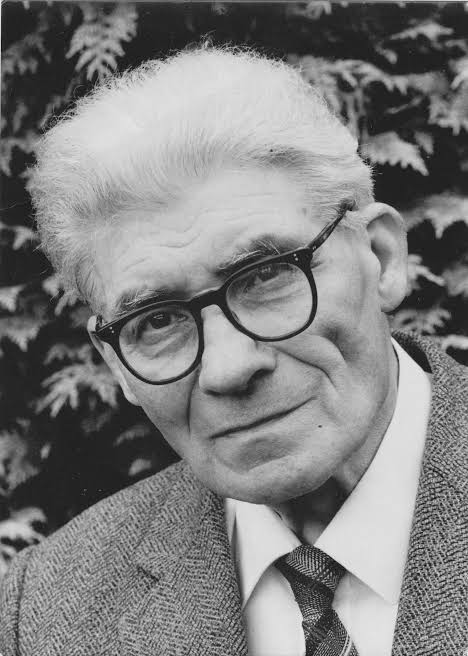
He held a number of academic posts, his final one (1970-79) being Principal Lecturer in Music at what was Huddersfield Polytechnic, now Huddersfield University. (Photo: The Critics’ Circle)
It should come as no surprise, then, that Sibelius grew increasingly drawn to Renaissance polyphony, most notably Palestrina, with its transparent modal counterpoint and homophony. In the opening of the Sixth Symphony, we do not encounter a single chromatic note until 47 bars in; up to that point, the music is entirely ‘white-note’ Dorian D (a device comparable to Beethoven’s in the third movement of his A minor String Quartet, Op. 132). Later, the gentle jauntiness of the finale’s opening could almost have strayed from a Tudor madrigal, while the modal, quasi-plagal final cadences of the first and second movements are fetchingly archaic.
As Truscott observes, the Sixth’s opening “recalls the logically-placed clashing of parts common in sixteenth century music, and yet is part of a forward-looking twentieth century style. […] Sibelius achieves a view of tonality possible only in this [i.e., the twentieth] century, while others were searching for ways to avoid it altogether.” Sibelius’s drive to condense his symphonic material would culminate in the single-movement Seventh and Tapiola. Even so, the Sixth, which continues to yield fresh magic with every hearing, remains a masterclass in succinctness.


What do you think? Comment and/or leave a reply.