Following the revelatory Diabelli Variations, Igor Levit confronts Beethoven’s formidable Hammerklavier, stripping away decades of romanticised weight for a performance that is dangerously radical.
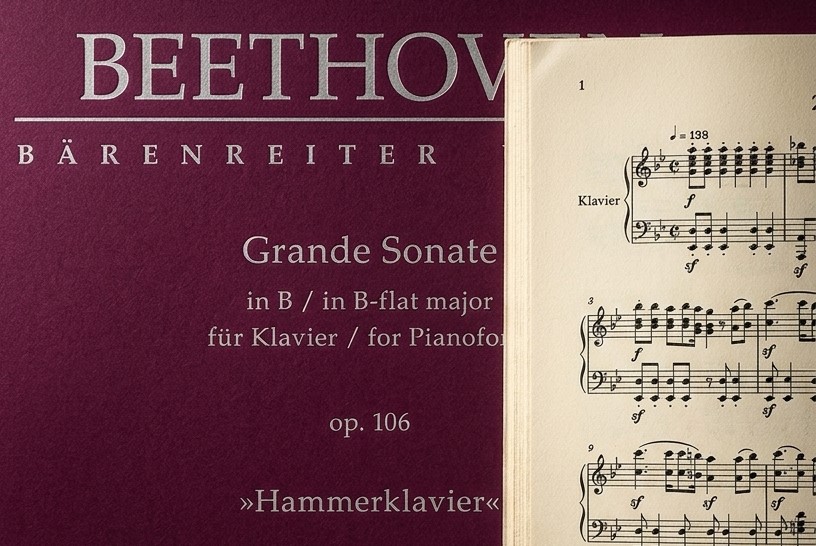
After the revelation that was Igor Levit’s Diabelli Variations, as discussed in my previous post, I steeled myself – for one can never casually approach Op.106 – for his 2014 recording of Beethoven’s largest piano sonata, No.29 in B flat, Hammerklavier, composed in 1818.
Running at just over 41 minutes, Levit’s is one of the shortest Hammerklaviers in the catalogue, mainly due to his rapid first movement, including its exposition repeat. For a long time, it was received opinion that the composer’s first movement metronome marking was incorrect. Donald Tovey ties himself in knots in his introduction to the work in the one-time ubiquitous 1931 Associated Board publication of all the sonatas. Here, Tovey suggests a minim equalling between 80 bpm (beats per minute) and 92, as against Beethoven’s own 138.
The problem with Beethoven’s very fast tempo isn’t, in fact, one of practicality, for it can be performed at, or close to, 138. The issue is that the first movement has been perceived as noble and heroic, a mighty edifice for which a slower tempo would aid a certain level of gravitas, if not self-indulgence. In truth, though, it’s nothing of the sort, because the whole idea of the opening isn’t some grand, majestic statement, but rather an explosion of energy. In this context, 138 makes complete sense, and this is how Levit plays it.
We know from Beethoven himself that he does not demand performers to slavishly obey his opening tempi for the whole movement. Rather, his expectation is for adherence to that tempo at the start to set the character, and then for the tempo to be flexible in order to capture the ‘sentiment’, as Beethoven puts it, of the music (see, for example, William S. Newman’s Beethoven on Beethoven: Playing His Piano Music His Way, 1988).
In discussing his 2024 recording, the much-respected Canadian pianist Marc-André Hamelin, argues, reasonably, that a metronome mark of 126 is fast enough. Some pianists have taken the opposite view, and the idiosyncratic Glenn Gould (1970) offers a ponderous performance at 80 bpm. His rendition across the complete sonata is almost nine minutes slower than Levit’s, and five slower than Hamelin’s.
Levit is loyal to Beethoven’s intentions in other ways, too, not least those places in the first movement where editors, over the past 180 years or so, have ‘ironed out’ what were thought to be typos in the score. The urtext (original text) on which Levit bases his performance (he uses the forensically-researched Bärenreiter edition, edited by the wonderful Jonathan del Mar, for all his Beethoven), not surprisingly reverts to exactly what Beethoven wrote, so that the so-called harmonic ‘false relations’, previously thought to be errors up until around 40 years ago, have been reinstated with the harmonic spice that Beethoven envisaged.
As a student, I questioned with my tutor some cumbersome fingering that Beethoven suggests in a passage of one of the middle or late sonatas, can’t remember which (not that I could play any of them). The tutor responded by saying that if that’s what Beethoven writes, then that’s what he wants. He was perhaps paraphrasing what Haydn said in order to counter those critics who queried the opening of Mozart’s Dissonance Quartet. In any case, Beethoven only very occasionally gives his own fingering or pedal markings, in those places where he wants a specific effect.
The point I make is that Beethoven was scrupulous in ensuring that his manuscripts, the copyist’s copies, and the first galley proofs, were signed off by him for accuracy. The ironings out, and edits, which have accrued post-1827, demonstrate something of the spirit of the age, but ultimately show a misunderstanding of the composer’s original intentions. It’s taken the best part of two centuries, but by 2020 Bärenreiter boasted that all of the composer’s major works were now available as urtext editions.
So how else is Levit’s performance authentic? Well, what isn’t authentic is, of course, his use of a modern piano. That’s of no concern as far as I’m concerned, as there’s no shortage of fine recordings of Beethoven’s works on period pianos for those who want them, and these are of undoubted historical interest. But let’s be really honest with ourselves and admit that for repeated listening, a modern Steinway, or similar, wins out in spades, and I can’t help thinking that Beethoven would have loved that sound. Not only did he say that the piano for which he was writing hadn’t yet been invented, but he himself saw massive developments in piano manufacture and technology in his own lifetime, and his advice was often sought by manufacturers.
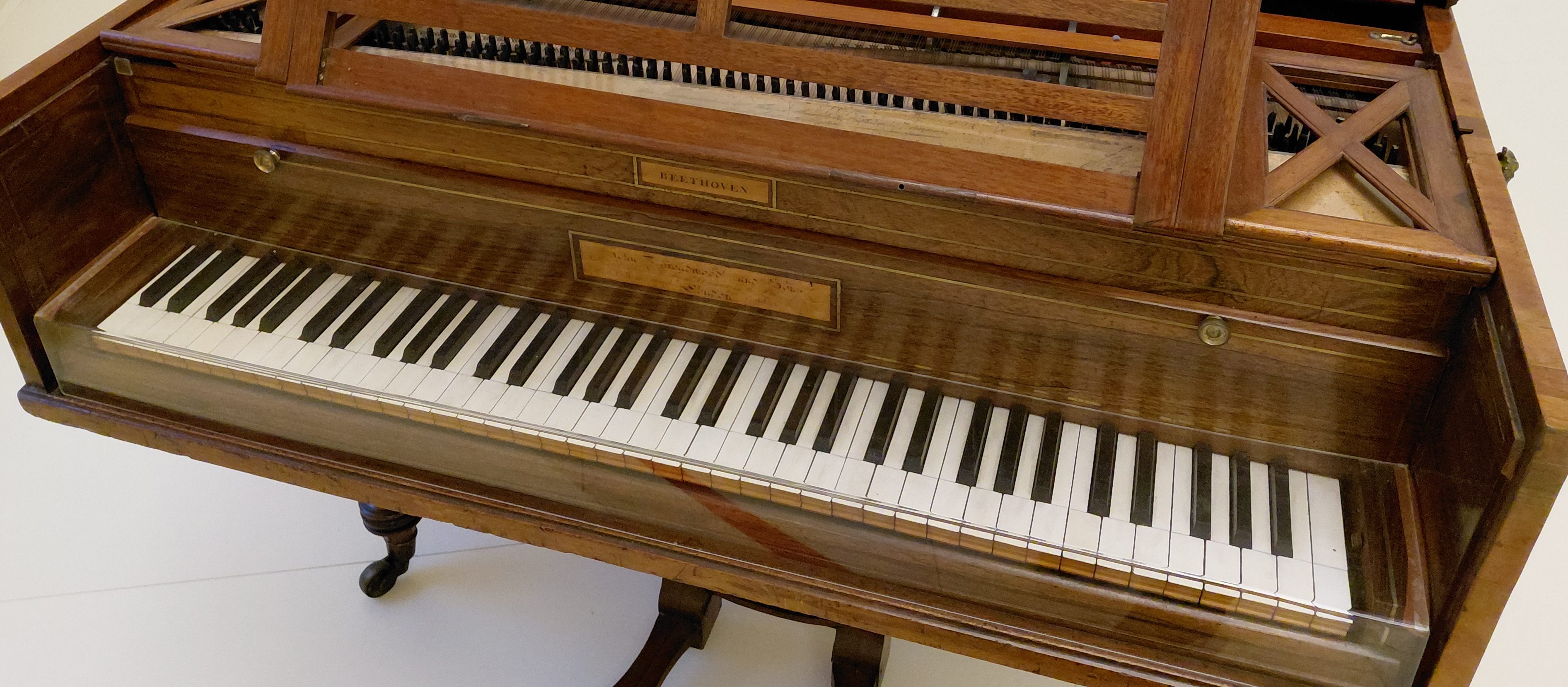
One thing that doesn’t work on the period instruments is the strident tone that some pianists feel is de rigeur for any performance of the Hammerklavier. A case in point is the first main climax in the first subject of the first movement, from bar 17 through to the wind-down at bar 31. Beethoven might be liberal with his loud dynamics here, and the tessitura is at times vertiginous, but it’s not a structural crescendo, only a bridge to take us towards the second subject. Why pianists miscalculate this and decide to bash this out is anyone’s guess. Even the legendary Alfred Brendel isn’t entirely innocent here, I regret to say.
Sforzandi on an 1818 piano are relatively tame when compared with what can be achieved on a modern instrument, and so here is where an eye on what sforzandi meant to Beethoven – and they meant nothing brutal, but were always part of the structure – has to be balanced with performance on modern pianos. Throughout this sonata, Levit never loses sight of this.
The Scherzo second movement entertains a conventional (in terms of structure) scherzo, plus two wayward trio sections. Levit approaches it as something of a light-hearted bagatelle to relieve us from the mighty first movement, and to help cleanse our ears in anticipation of the epic third. His playing is totally delicious.
That vast third movement is Beethoven’s longest, and surely his most complex, piano sonata slow movement. Here, the problem is always one of maintaining the narrative of this infinite song, for that’s what it is, to sustain the ‘passion’ and ‘sentiment’, to use the composer’s own words. The slow movement begins in a very intimate way, and Beethoven’s instructions are explicit in this respect. Though very slow, it is, nonetheless, in a compound duple metre, and it’s folly amongst those pianists – and there are some – who count six in a bar, rather than two slow dotted crotchets. Levit appreciates this, and gently pushes the pulse whilst maintaining the stillness. Listen, nay, marvel, at his cantabile, where the top notes of the right hand sound as though they’re being played on a separate piano. It’s so tender.
“I’ll show ‘em what I can do, how many notes I can play loudly, quickly and accurately within a short space of time,” is too often the mantra of dexterous, yet foolish, pianists in the showcase, crazy, fugal finale. Unlike the first movement, this one isn’t an explosion, but is a marriage of the linear and textural. Once percussive dynamics and histrionics are eschewed in favour of exploring the balance between texture and structure, then this finale becomes remarkably lyrical in Levit’s hands. Typically, Paul Lewis, a musician’s musician if ever there was one, achieves something similar in his 2006 recording.

Levit’s ploy in the finale makes total sense, because we’ve just emerged from the vast third movement. Those who bash and thump their way through the finale misunderstand the emotional weight of that Adagio sostenuto, because the finale has to be placed, indeed poised, in relation to it. You don’t need to make the finale more immense than it already is, when the third movement is massive; it’s all written into the notes.
The work wasn’t recorded until 1935 (Schnabel). It never received a public performance in the composer’s lifetime. Even when it did (Franz Liszt in 1836), subsequent performances were relatively rare, as there were precious few pianists who could manage it.
Levit’s isn’t the only view of the Hammerklavier. The music is so durable that it can withstand the heroics of a Daniel Barenboim, the detachedness of a Brendel, the historically informed performance on actual, or replica, period instruments by, for example, Ronald Brautigam, or an essentially 19th century approach by someone like Artur Schnabel, born less than 65 years after the Hammerklavier’s own birth.
All of these, and more besides (I’m almost embarrassed not to have mentioned terrific performances by Stephen Kovacevich, Maurizio Pollini and the ever-wonderful Murray Perahia) are more than worthy.
But at the moment, Igor Levit seems to have wormed his way into my ear. Long may he stay there.


What do you think? Comment and/or leave a reply.