Drawing on personal insights from the composer himself, Sir Adrian Boult spent nearly six decades, from his first 1920 performance to a luminous 1977 Proms performance, revealing the true depth of Elgar’s Second Symphony.
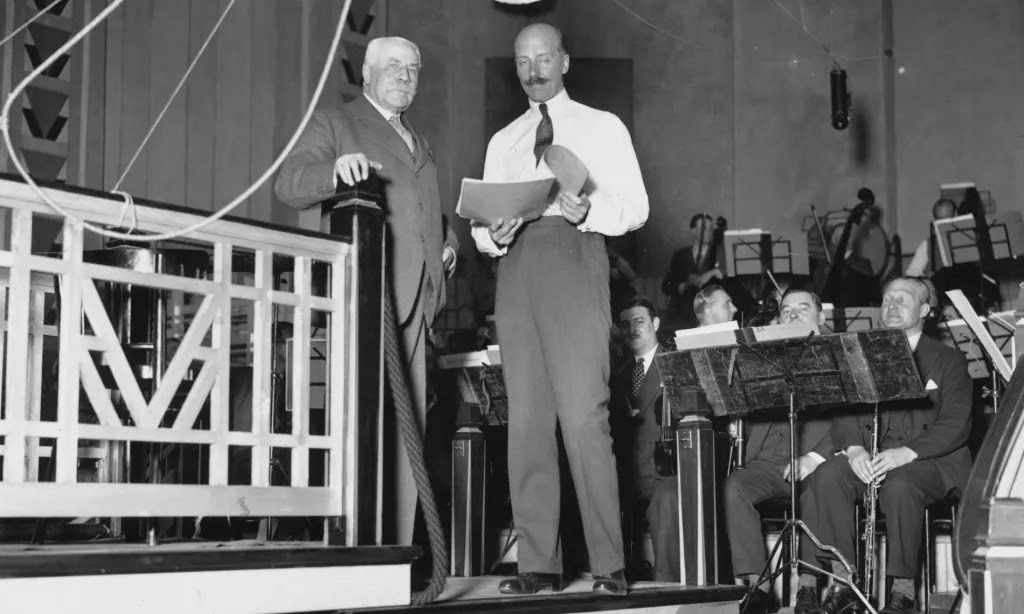
(Photo: Hulton Archive / Getty Images)
Adrian Boult first conducted Edward Elgar’s Second Symphony (1911) in 1920, and his final performance was in 1977. He made eleven recordings of it, of which six have been released. In total, there are around 40 recordings by various artists, including two – the first a truncated version – conducted by the composer. For a 20th century symphony, the choice is therefore wide.
Boult’s recordings are of special historical importance, because he discussed performance aspects of the work with Elgar himself who, in turn, highly regarded the young conductor’s interpretations. In addition to Elgar’s 1927 recording with the London Symphony Orchestra (the 1924 acoustic recording is essentially a historic curio), we know, according to Nigel Simeone’s seminal book Edward Elgar and Adrian Boult (2025), that Boult heard Elgar conduct the work on at least five occasions. From the outset, Boult wanted to put his own mark on a work which, when he first conducted it, was less than 10 years old.
On the basis of timings alone, his performances differ from Elgar’s. The composer’s 1927 recording remains the shortest extant version, coming in at 47 minutes. On the available evidence, Boult’s durations remained a good four or five minutes longer than Elgar’s, though it should be understood that the latter’s performances of his own works are, in general, somewhat brisk compared to other conductors. During the past 30 years or so, the Symphony has slowed down further, with some of the more recent recordings nearing, and even exceeding, the 60-minute mark.
Boult’s longest recording of the Symphony, at 53:02, is his 1975 one with the London Philharmonic. Though not much longer than any of his others, it somehow sounds more spacious, perhaps due in part to the generously engineered sound, and the LPO’s characteristically warm, though not especially bright, tone.
In truth, any of the Boult performances are worth a place in one’s recording library, though with one or two caveats. For example, the strings of the Scottish National Orchestra, recorded in 1963, though very good, were no match, at that time, for the London orchestras in other recordings. With the London Philharmonic’s 1968 recording, Boult was reluctantly persuaded to have all the violins placed on the left, rather than his customary placing of first and second violins to the immediate left and right, respectively, of the podium. It is, I feel, a misjudgement, because Boult normally balances and blends his sound with the split violins in mind.
Which brings me to my two favourite Boult recordings. His final word on the Symphony was for the Proms in July 1977. That broadcast was my first introduction to this mighty composition, and I was hooked by it from the start. By then, Boult was 88 years old, and had become increasingly frail, so that his workload had to be carefully monitored. Conducting the Second Symphony requires immense stamina. I remember seeing one of my conducting heroes, Charles Mackerras, who was then in his late 70s, conduct it in 2002. He walked onto the platform sprightily enough, but 55 minutes later, his exit was more ponderous, less assured, though the performance was characteristically grand and reflective in equal measure.
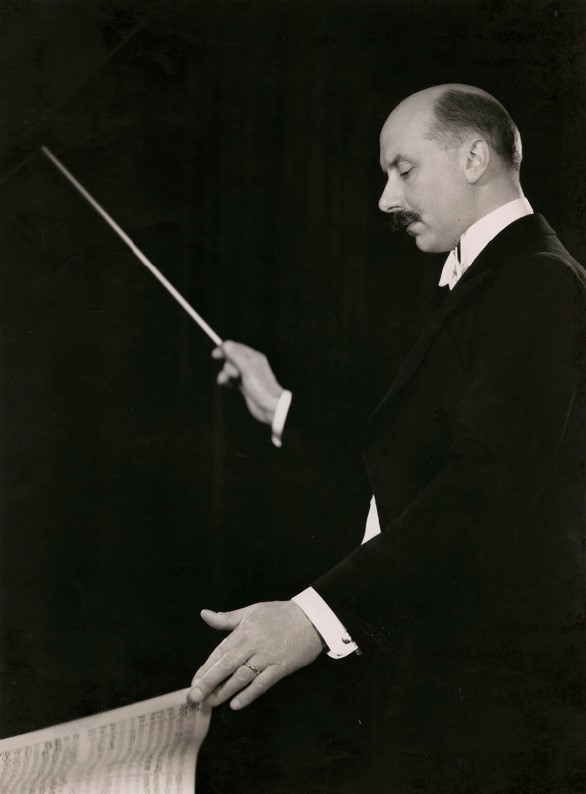
Boult’s long association with the orchestra he founded in 1930, alongside the affection the BBC players always held for him, shines through in his luminous 1977 performance. If, by its close, he felt fatigued, there is no hint of this in those shimmering final pages.
More than 30 years earlier, in 1944, Boult, with the BBC Symphony, made his first recording of the work. It has since been remastered and issued by Pristine Classical, which has developed audio restoration into a fine art. Consequently, the 1944 recording sounds crisp and fresh, and its lack of stereophony – something which does not bother me in the least – is compensated by a sense of space which belies its age.
The performance is a clear demonstration that the BBC Symphony had become, within a short time, world-class under Boult’s baton. Indeed, his tireless championing of contemporary 20th-century British symphonies extended into his later years. It was the octogenarian Boult who conducted the BBC Northern Symphony Orchestra in the 1969 premiere of Lennox Berkeley’s Third Symphony, a work explored in last week’s post.
Boult’s readings of Elgar’s Second Symphony, and in character with his style of interpretation, are never sentimental. But he treads a fine line between Elgar’s own no-nonsense approach, and something which, I have to say, goes far deeper than the composer’s recording. Then again, Elgar was a competent, and in many ways good, conductor, whereas Boult was truly great, and could penetrate the inner recesses of any work without recourse to self-indulgence. I say this because Elgar’s Second Symphony can, in parts, sound maudlin if the conductor allows it to.
As a postscript, it’s worth mentioning John Barbirolli’s acclaimed 1964 recording with the Hallé Orchestra. This was the first recording of the work that I bought, so my judgement of the work was, and I think still is, coloured by it. I adore it, for Barbirolli’s majestic sweep of the Symphony, for the Hallé’s impassioned playing. So, if I could choose just two recordings, they would, without any doubt, be this one, and Boult’s 1944 version.


What do you think? Comment and/or leave a reply.