What happens when supreme physical economy meets Rachmaninoff’s most demanding concerto? Yuja Wang balances restraint with grand architectural vision in a performance of uncompromising romantic sweep.
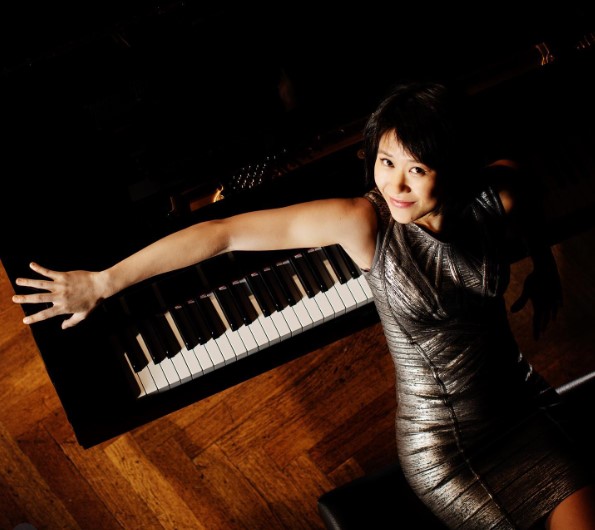
In my two previous posts, I’ve been discussing Igor Levit’s Beethoven (The Diabelli Variations, and The Hammerklavier Sonata). This time round, my attention focuses on Yuja Wang, a very different, though equally perceptive, pianist, and it’s Sergei’s music, rather than Ludwig’s, for this article.
I first heard Yuja Wang live in 2018, realising immediately that there was something extraordinary about her musicianship. The following year, she performed Sergei Rachmaninoff’s Third Piano Concerto (1909) with the Vienna Philharmonic conducted by Andrés Orozco-Estrada at the Macau Cultural Centre. The film of that captivating performance, discussed below, can be watched on YouTube here.
Chinese-born, but having studied and lived in the USA, she was tutored by the renowned Gary Graffman in Philadelphia. In her early career she deputised for the indisposed Radu Lupu and Martha Argerich, which says something about her standing when only in her mid-20s. She might have since enhanced her reputation with her trademark skimpy, eye-catching dresses, but this is all part of the physical and visceral nature of what she does and what she is.
Wang is especially well-known for performing the large-scale Romantic and post-Romantic repertoire. Chopin, Rachmaninoff, Prokofiev, Tchaikovsky, Ravel, and Brahms, along with virtuosic encore ‘lollipops’, are all central to her repertoire. Debussy less so, and Bach and Mozart don’t feature in any significant way. Her Beethoven Hammerklavier has attracted critical acclaim, a gigantic work which sits well with her style. In all of this, then, she tends to mirror Vladimir Horowitz or Argerich, rather than, say, the ‘classicists’ Alfred Brendel, Murray Perahia or András Schiff.
Rachmaninoff’s D minor Concerto enjoys a fair amount of iconic recording history, from the composer himself, his friend Horowitz’s five recordings, and Vladimir Ashkenazy’s still-stupendous 1963 recording, among others. The work is considered to be one of the most technically demanding piano concertos in the regular repertoire, and for reasons of sheer stamina, and perhaps to shorten its duration so that it could fit more comfortably on 12-inch 78 rpm discs, the composer suggested optional cuts, though nowadays these are thankfully never observed. In any case, coming in at around 43 minutes, the work is not much longer than Beethoven’s Emperor Piano Concerto (No. 5), a good 10 minutes shorter than Brahms’s Second Piano Concerto, and only slightly shorter than Rachmaninoff’s own previous concerto.
Wang’s technique is formidable. The massive leaps and lightening-speed runs are achieved by her hands staying very close to the keys. Rarely are they raised above the keyboard lid, so that in terms of distance, her reach doesn’t need to be all that far. Her movements are always economical, her lower body hardly moving, apart from pedalling, and she barely shifts on the bench. Put it this way, whatever Lang Lang does, Wang doesn’t.
The way in which Wang paces the concerto has as much to do with her understanding of Rachmaninoff’s macro-structure, as well as the microstructures within, and balancing these with a range of colour and dynamics. For example, a passionate fortissimo is meaningless unless the colour and balance of textures are understood, and this is no better demonstrated than in the middle movement where climaxes become cumulative, rather than ends in themselves, thereby helping to shape the total edifice and its dense textures.
The Third Concerto’s overall form is not as taut as in the Second Concerto, and I think this is why the composer was amenable to some cuts. There is, to be sure, more note-spinning and passage work than in the Second Concerto, and this can sometimes be heard as a weakness under a pianist who lacks the imagination of Wang. Sprinkle magic and fascination amongst those relatively weaker passages, and the results can be irresistible.
I always worried about the over-long E flat pedal which takes up much of the slower section before the finale’s coda. But my concerns were totally banished under Wang’s fingers. And with the wondrous Vienna Philharmonic – what a sound! – under the fabulous Andrés Orozco-Estrada, Rach 3, as it’s affectionately known, remains a major 20th-century concerto.
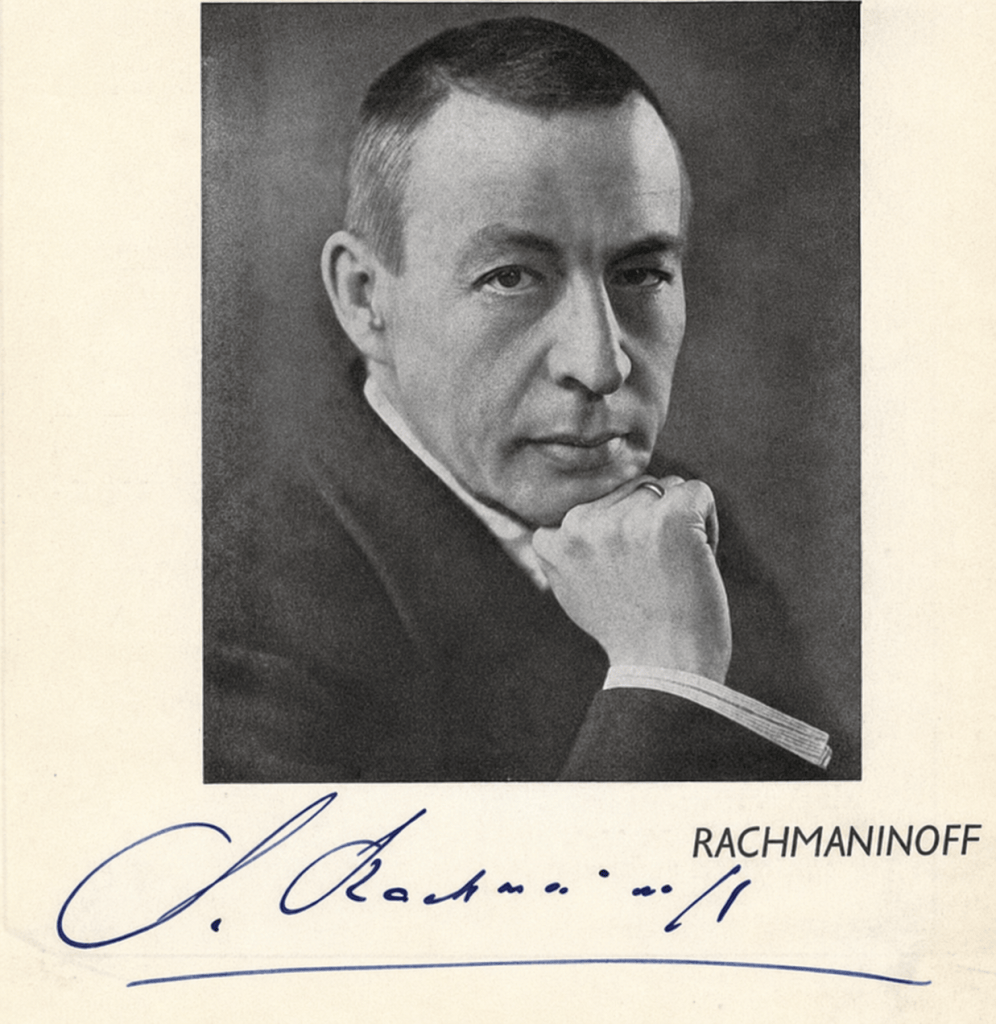
By way of a postscript, the spellings Rachmaninov and Rachmaninoff are both correct, but the composer preferred the ‘ff’ version once he settled in the USA in 1918, as demonstrated in the image of this photo and autograph. (Photo: Kubey-Rembrandt Studios, Philadelphia, 1921)


What do you think? Comment and/or leave a reply.